
Oracle NetSuite Intelligent Payment Automation
Industry
Financial Software
Client
Oracle NetSuite
Tags
Product Design, Enterprise SaaS, AI Systems
Time
2025

What is AP Automation?
In the world of accounting, there are countless tedious yet critical tasks required to ensure companies pay the right vendors at the right time. One of these processes is Accounts Payable (AP)—the business operation of paying money that the company owes to others, usually suppliers or vendors. When a company buys goods or services for operation, it receives a bill or invoice. AP teams make sure that bill is reviewed, approved, paid on time, and recorded correctly for bookkeeping. In simple terms, AP is how a business manages and pays bills.
Traditionally, AP has been manual, error-prone and frustrating, resulting in operational risk and cost for finance teams. Thus, AP Automation is software that helps make the process faster and more accurate, reducing time, cost, and mistakes. Instead of using spreadsheets, paper checks, or bank portals to complete tasks, AP teams can use automation that brings these tasks into one workflow. At NetSuite, this means helping our finance team customers through certain steps:
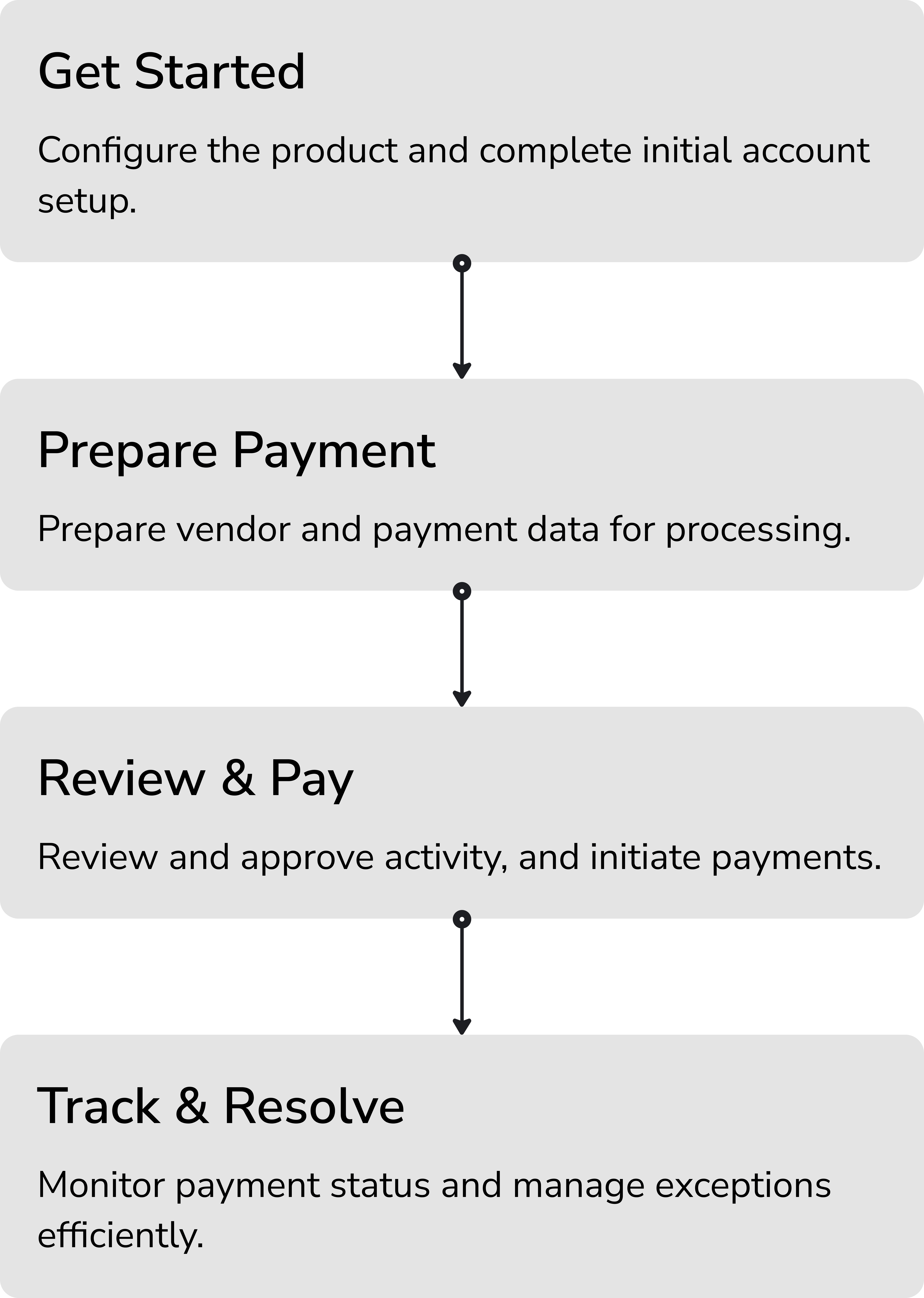
Get Started
Configure the product and complete initial account setup.
Prepare Payment
Prepare vendor and payment data for processing.
Review and Pay
Review and approve activity. Initiate payments.
Track and Resolve
Monitor payment status and manage expectations efficiently.
Overview
NetSuite's AP Automation has long been a core module within its accounting suite. While it significantly reduced manual effort, key pain points persisted — setup was cumbersome, the experience felt fragmented, and users lacked confidence in the payment process.
When a new partnership with BILL.com was announced, it introduced both an opportunity and a challenge. BILL.com is a financial operations platform that handles the secure payment processing layer, acting as the engine that moves money from a company's bank account to their vendors. Because BILL.com operates as a separate service, users would step outside of NetSuite to complete certain payment actions, creating a fragmented experience at a critical moment in the workflow.
This partnership required building a new product from scratch, and with it came the opportunity to rethink the full AP experience. The goal was a seamless integration that could absorb BILL.com into the workflow without disrupting the user's sense of place or control.
Thus, Intelligent Payment Automation (IPA) was released in 2025 as the successor to the previous AP Automation solution and launched at SuiteWorld 2025 as a flagship AI initiative.
Intelligent Payment Automation was launched at SuiteWorld 2025 as a flagship AI initiative. See the official NetSuite product guide and demo below!
Problem
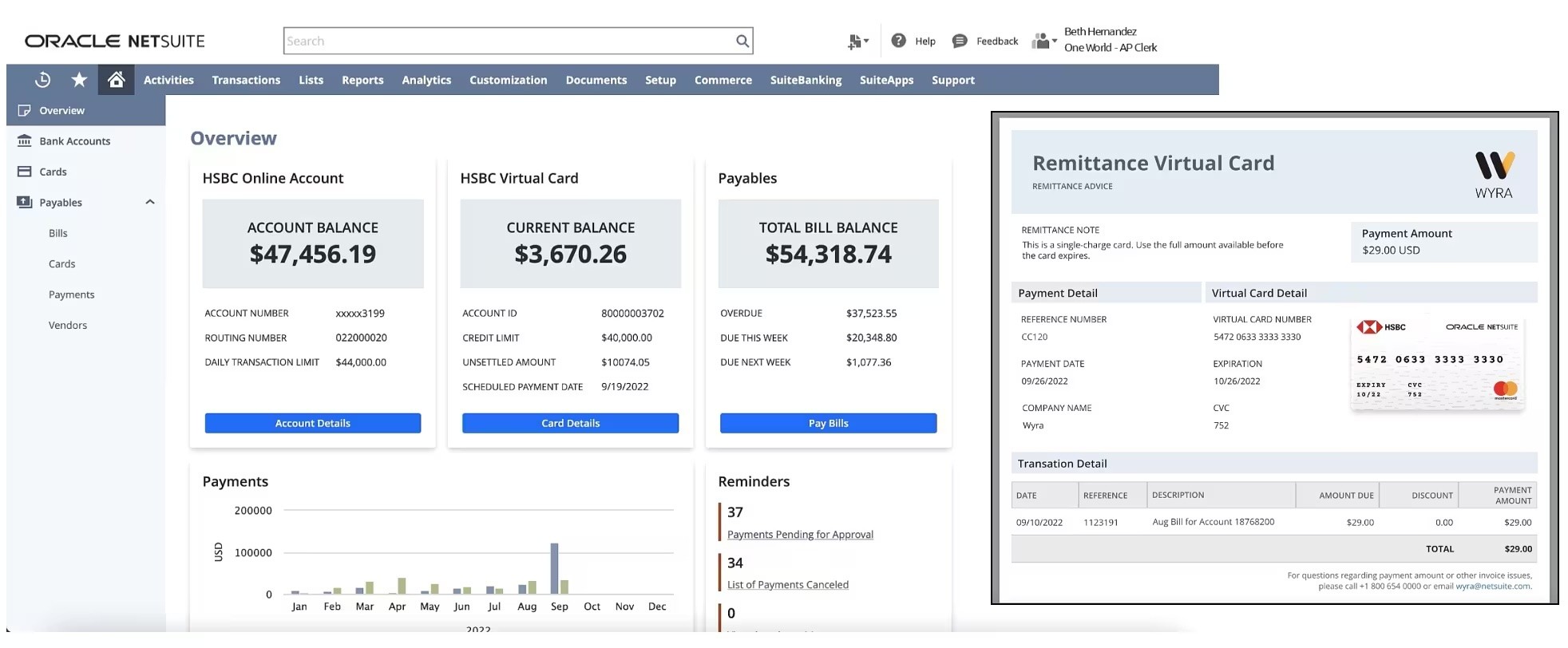
While NetSuite AP Automation was a crucial product of customers, it had crucial issues that made the payment process. Here were the three biggest pain points from users that we aimed to solve.
Fragmented payment process
The AP experience was spread throughout the system and even to other applications outside of NetSuite.
The current AP Automation experience is not only difficult to set up, but also feels not fully integrated into NetSuite, which makes it harder for users to complete payment tasks with confidence. With these issues combined, the payment system that was difficult to trust and even harder to scale.
In light of a new BILL.com partner integration, we were presented the opportunity to redesign the full AP experience to build a truly user-friendly product.
Solution
We launched Intelligent Payment Automation (IPA), delivering a fully NetSuite-integrated experience that supports users throughout the payment journey. With a guided experience, IPA introduces a structured workflow with contextual guidance, clearer system status, and improved dashboard-level visibility into payment activity. The goal is not just to help users complete AP tasks, but also to help them understand where they are in the process, what needs attention, and how to take the next step.
IPA simplifies payments, provides real-time visibility into outgoing cash, and enables faster adoption through self-service onboarding. The result: tighter control of outgoing cash and scalable, end-to-end AP, which allows users to complete their accounting tasks and, in turn, trust NetSuite.
Guided self-service onboarding
Previously, users entered AP Automation installation with little context. They would have to piece together the correct onboarding sequences on their own using scattered resources: external videos, NetSuite help documentation, and external support.
With IPA's new self-service onboarding procedure, set up is a guided, in-product experience instead of an empty starting point and convoluted process.
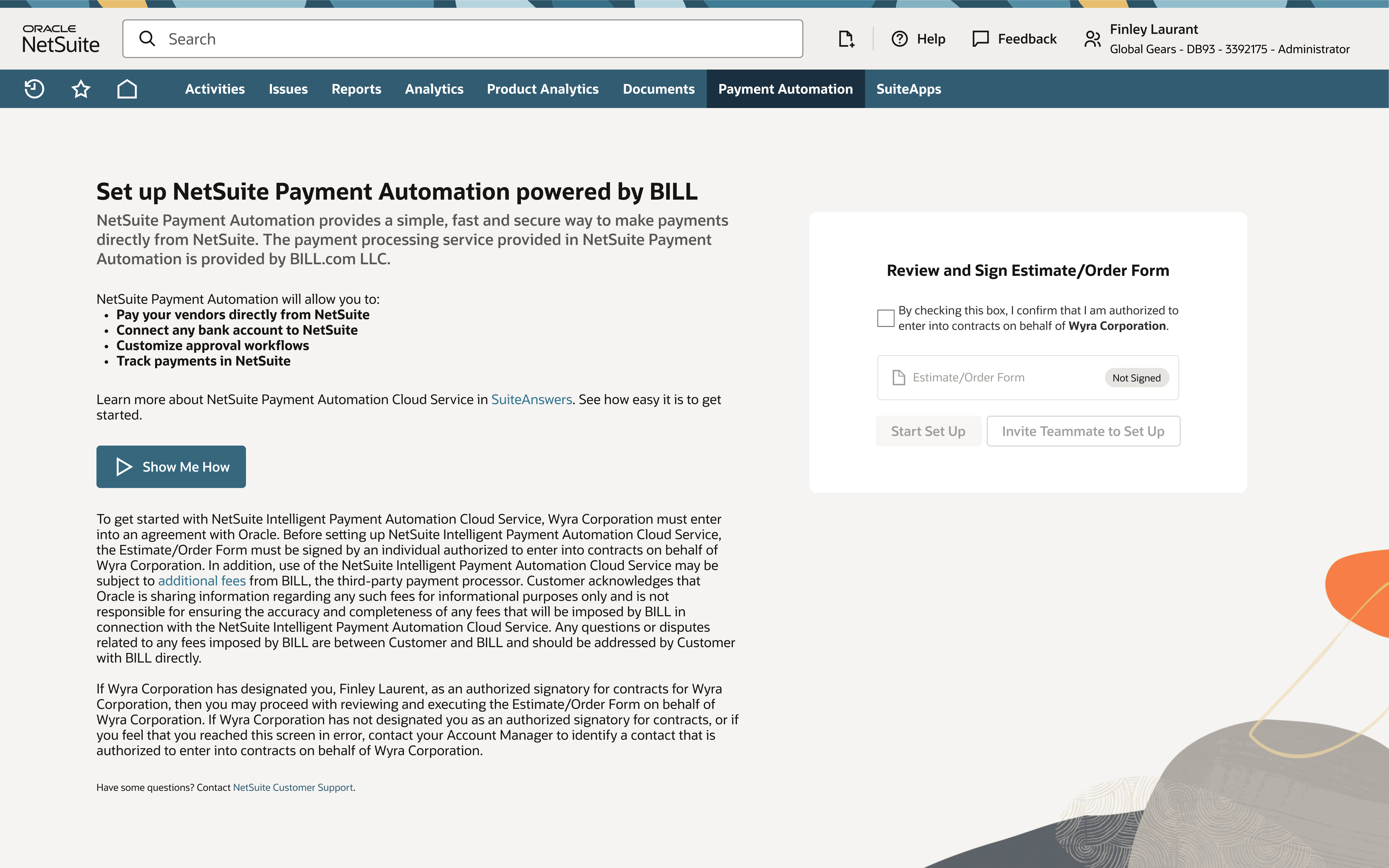
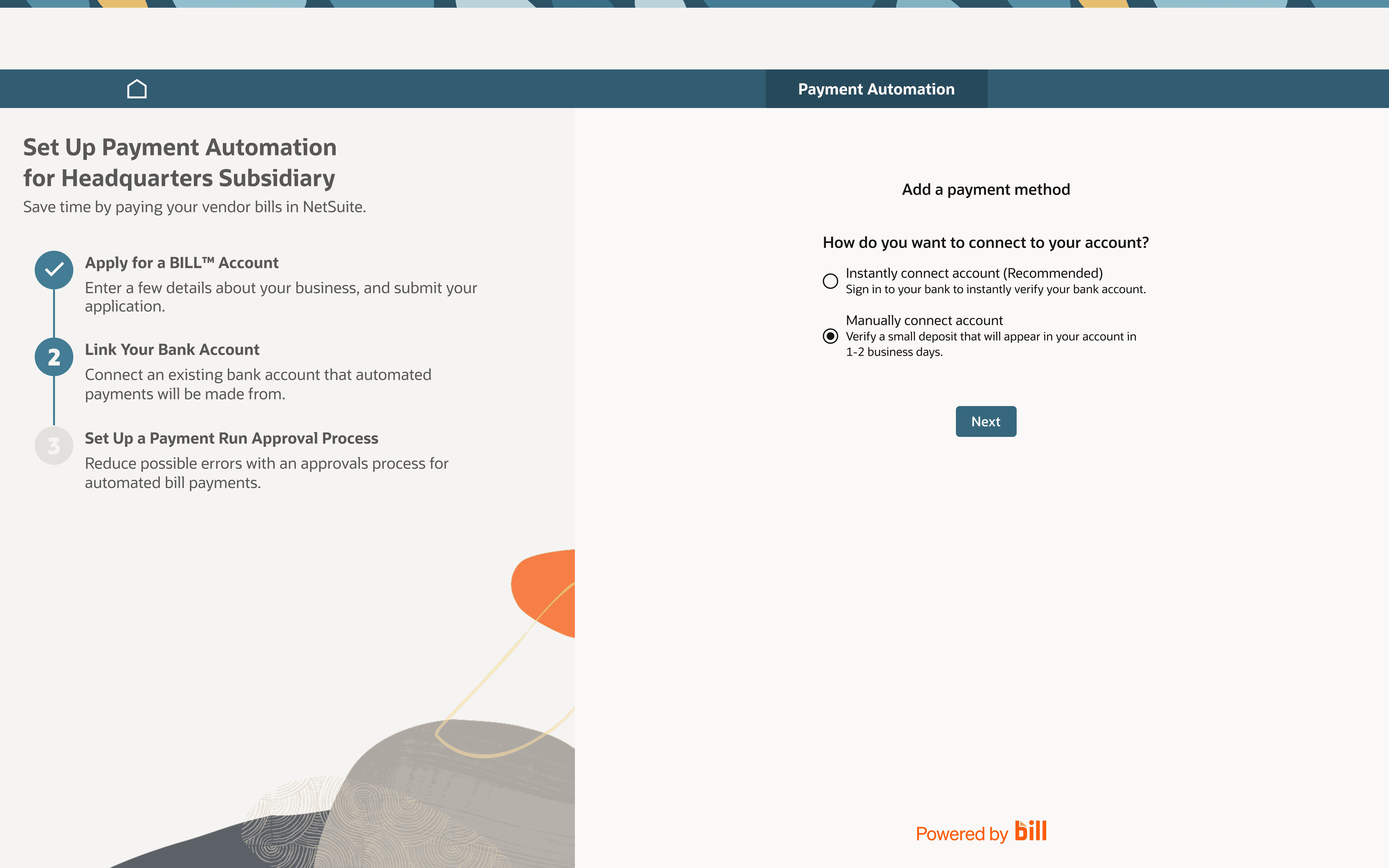
Setting Up Payment Automation
Following installation of IPA, the user is introduced to the functionalities of the product and detailed disclaimers.
In addition, a CTA provides a link to a video demo of how IPA works. The white box on the right highlights the first step of the onboarding process: signing legal documents.
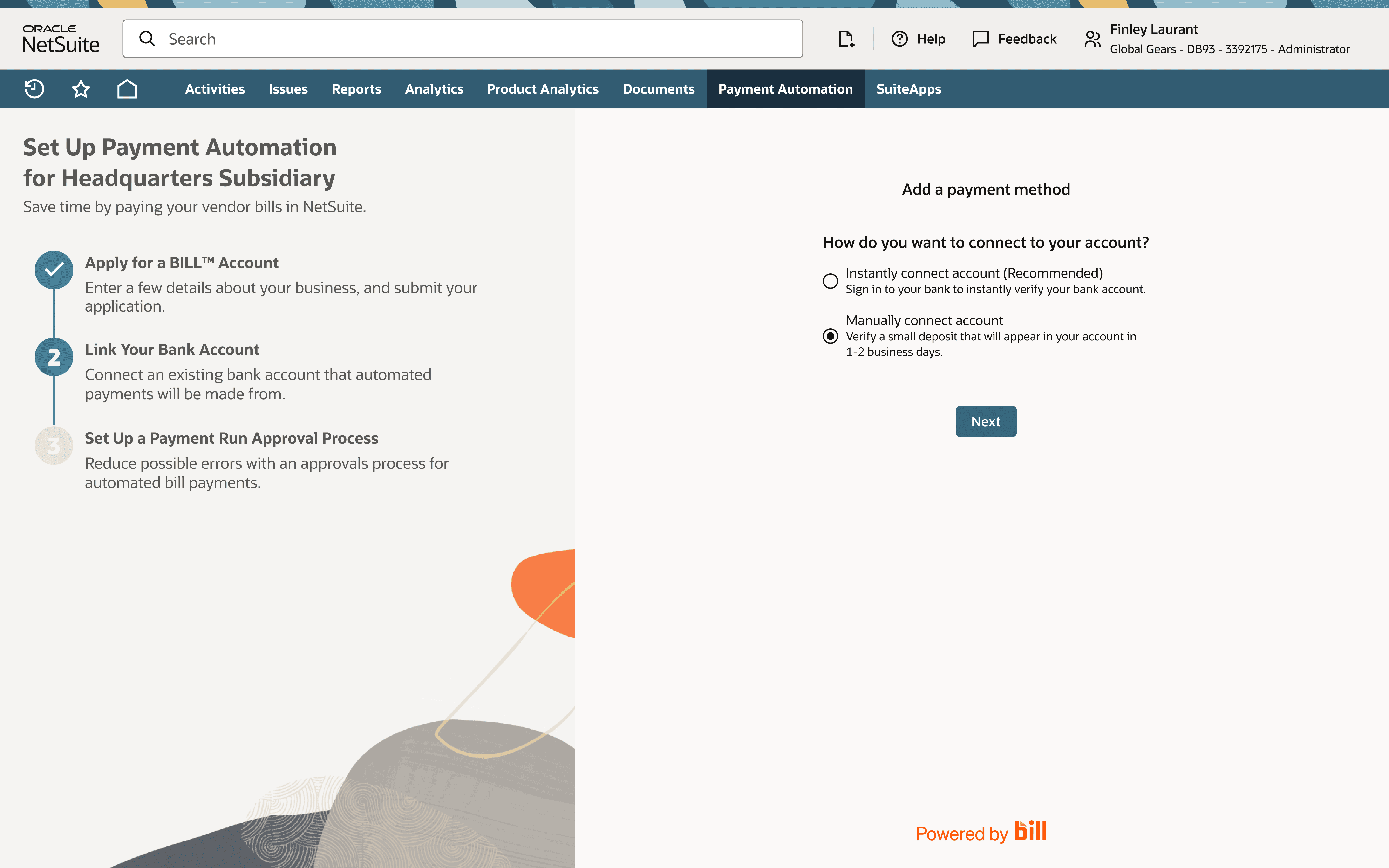
Payment Process
A reimagined payment dashboard provides insight into what needs to be done through recommended action and reminders portlets. In addition, there is a focus on the relevant elements of payment: payable balances, account register, and bank account connectivity.
In addition, the left side navigation has been redesigned to mimic the process of the AP process, as well as allow users to easily make setting changes.
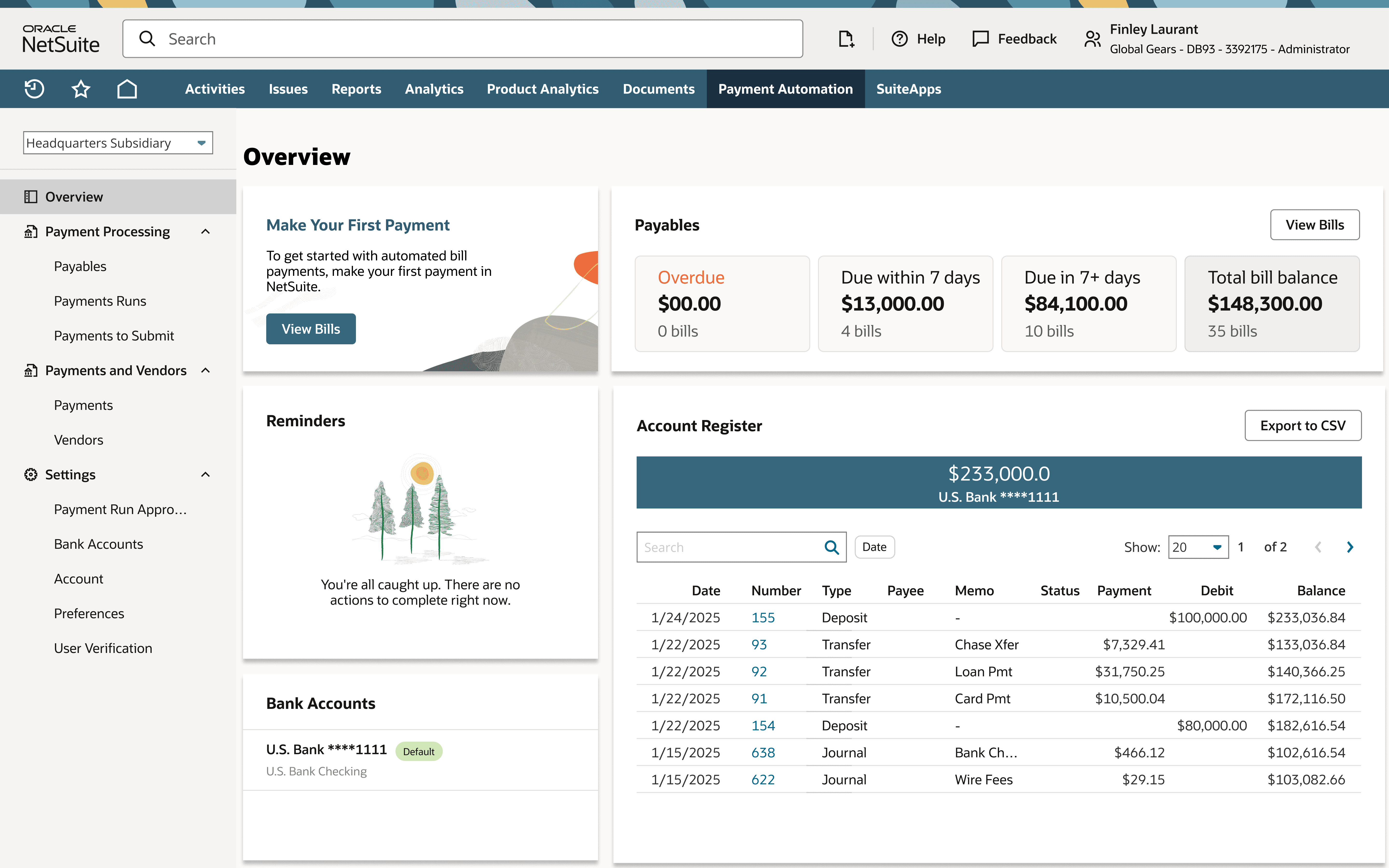
Previously, payment work was spilled into bank portals, manual checks, and external apps. Now, the bulk of the critical processes can be accessed in the left hand navigation, allowing users to manage all things AP related in one place.
For example, relevant bank details can be accessed and managed through the side panel without the user being redirected to another place in NetSuite.
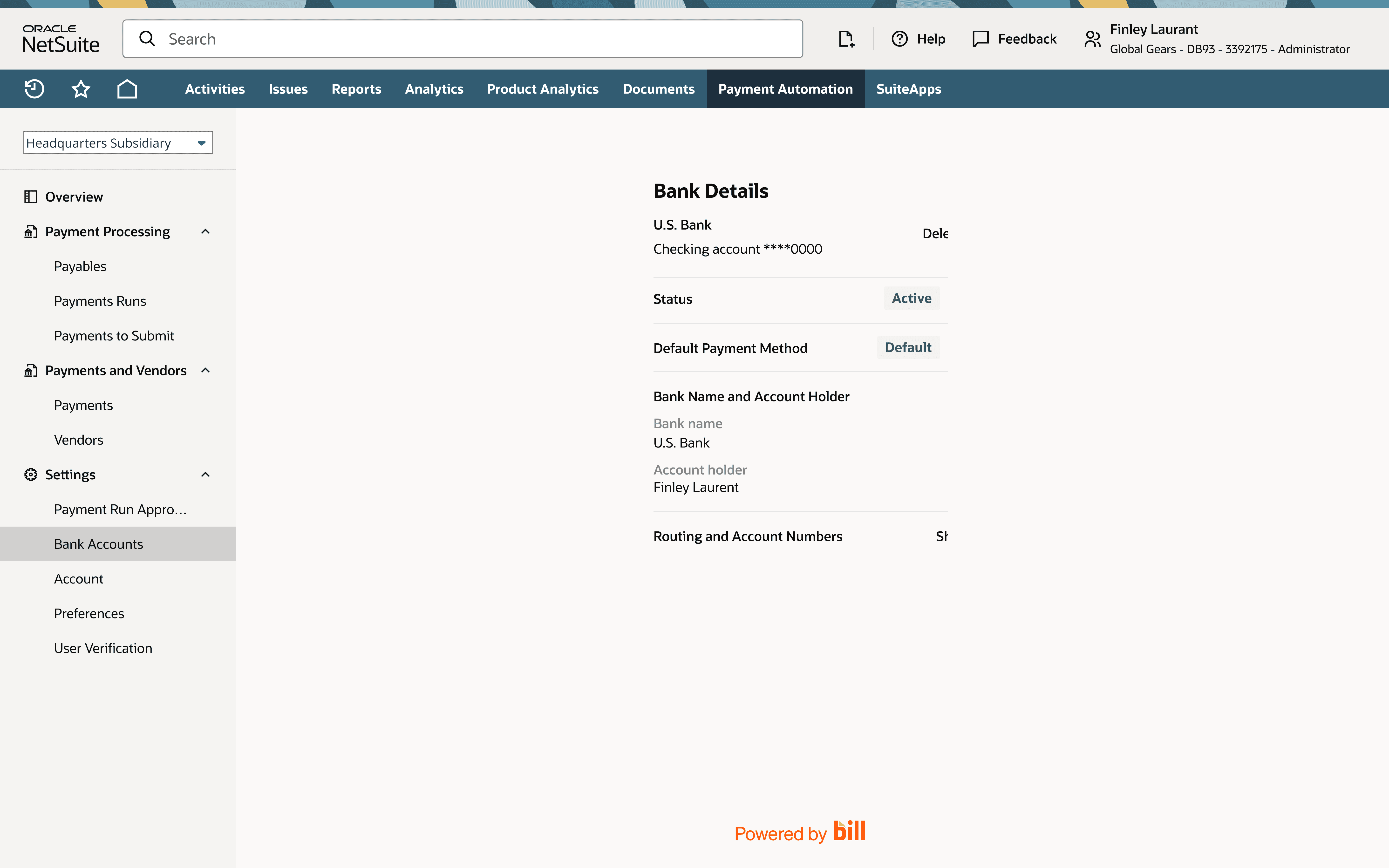
Bank Accounts Page
Status Visibility and Indicators
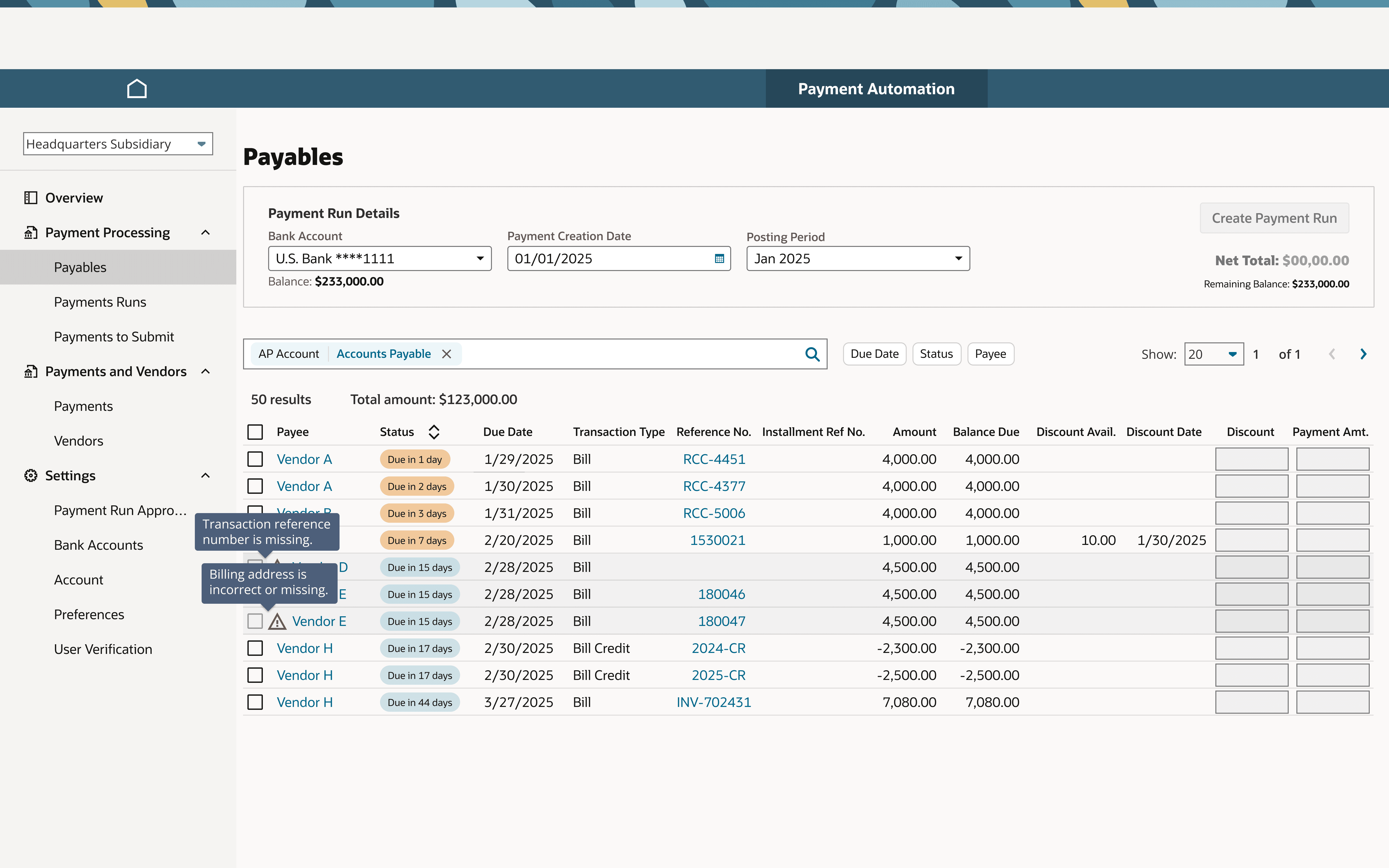
Date-based filter chips, as shown under status, is a new UI introduction. As payments are heavily prioritized by their due date, these chips allow users to quickly identify which payables to address first.
When designing error icons, we worked with tech writers and developers to ensure that the communication regarding the error clearly indicates to users what needs to be fixed.
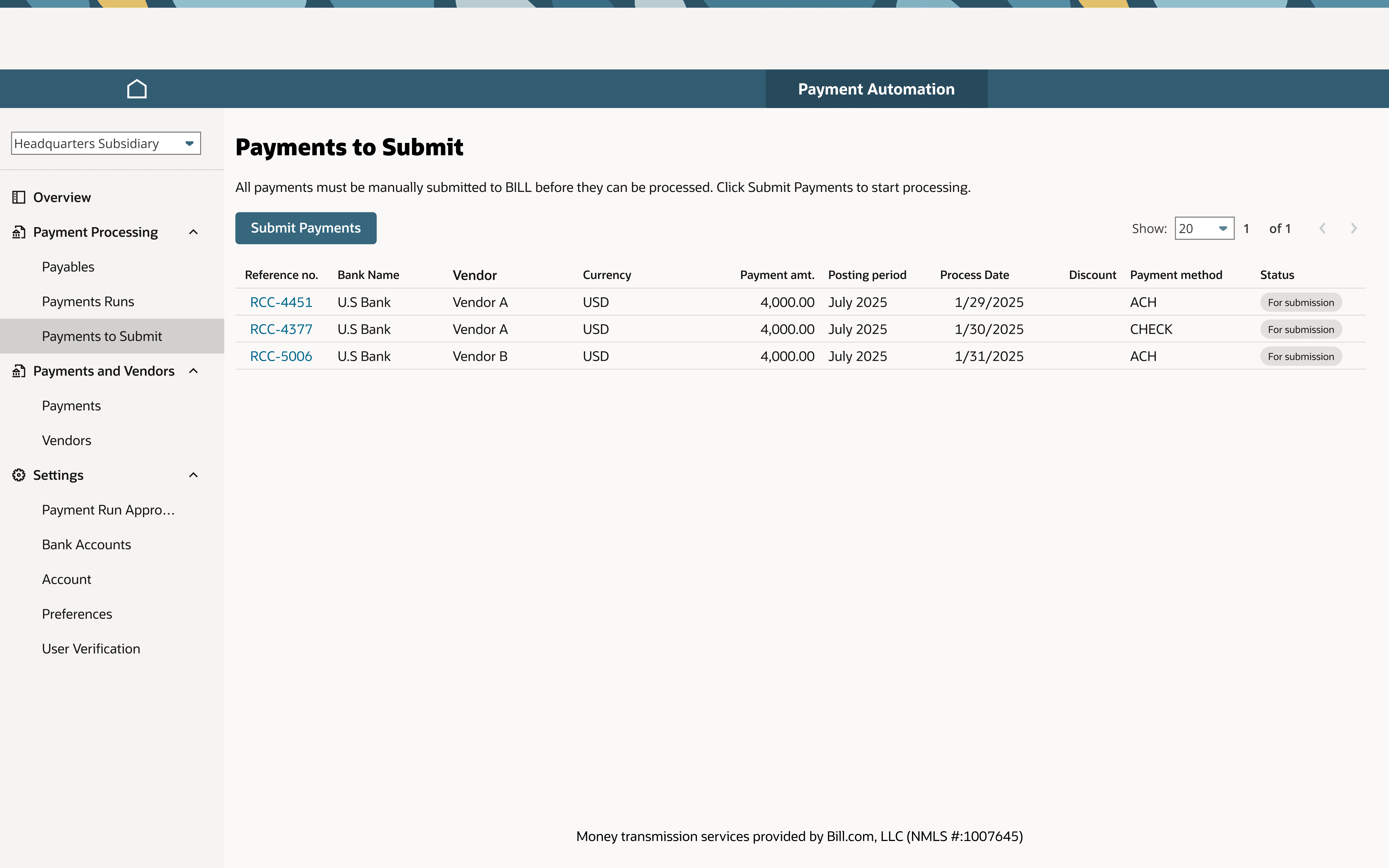
Payment Dashboard
Making payments requires many steps, and the left hand navigation guides users through those steps.
In addition, the left side navigation has been redesigned to mimic the process of the AP process, as well as allow users to easily make setting changes.
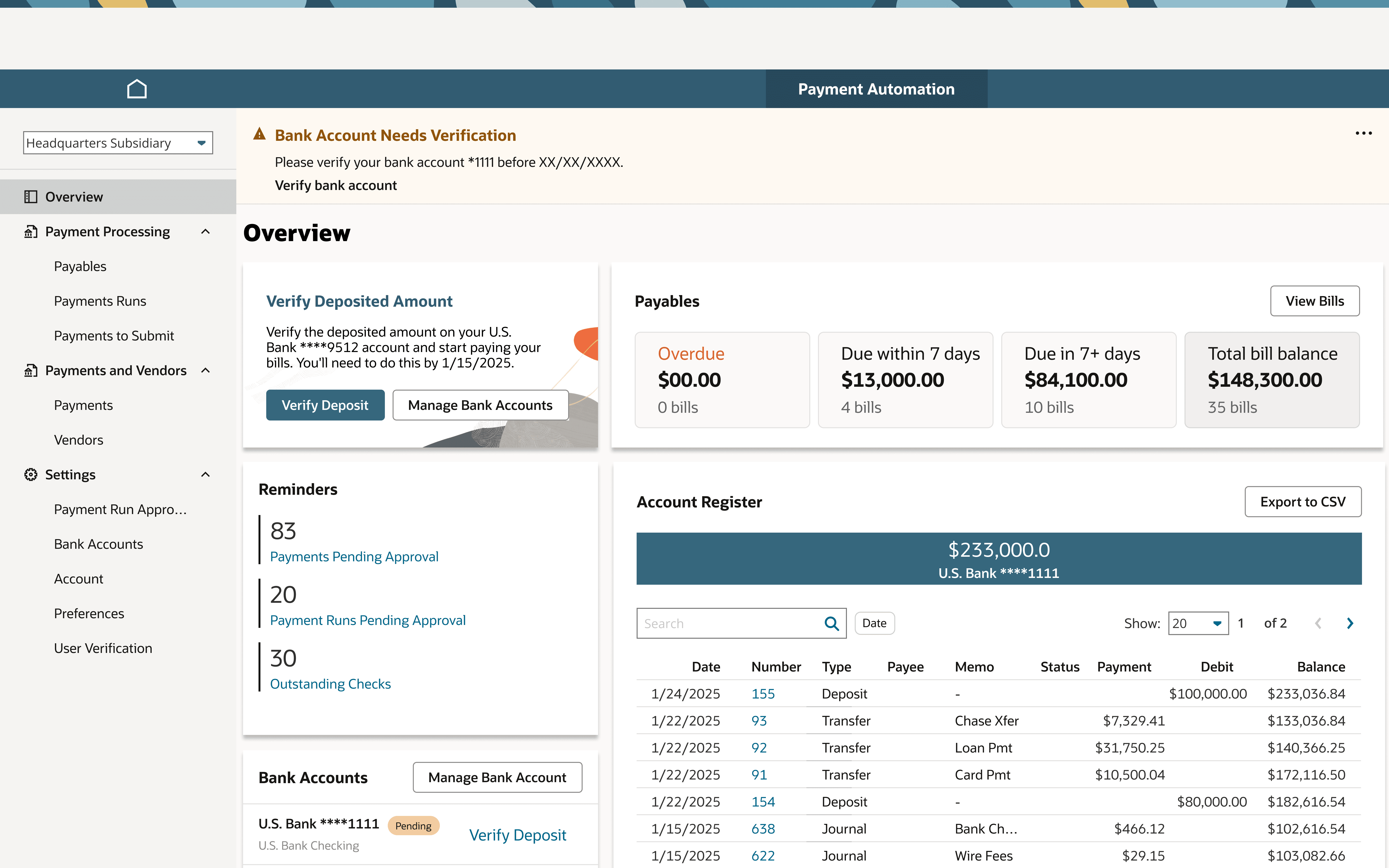
Payment Dashboard with Banner
Managing AP workflow isn't always linear, and there are many factors that may affect the payments process, such as bank account verifications and connections.
Through a system of banner alerts, IPA alerts users on what needs to be done to continue completing AP tasks.
Collaboration with Design Team
I collaborated closely with a designer and visual designer, dividing ownership across IPA’s surfaces. Through regular critiques and alignment sessions, I ensured our work cohesively met product goals and adhered to the NetSuite design system.
Managing Consistency
IPA spanned 100+ Figma screens across a high-visibility, leadership-facing deliverable. I took ownership of design consistency, which included auditing and enforcing fonts, colors, components, and spacing to ensure every screen was pixel-perfect and presentation-ready.
Conducting Design Quality Assurance
Before launch, I led a full design QA audit of the engineering team’s implementation, identifying UI and experience gaps against the design spec. I built and maintained a dedicated tracking system to manage fixes, helping drive a quality, on-spec product release.
Working on a project this complex and high-stakes was no easy feat, but navigating its many moving parts taught me a lot. Collaborating closely with developers, product managers, SMEs, the BILL.com team, and legal pushed me to work through ambiguity while also respecting strict constraints. Most importantly, it sharpened my ability to advocate for the user and push for the best possible experience, even when the path forward wasn’t always clear.